surface
Being interviewed?

Uses

  1. IPeople and culture
  2. IICustomer experience
  3. IIIOperations

For

More

Book a conversation

Operations and process

You ask what happens between the order and the invoice, and every team describes a different process.

Surface reads the event history of the work while AI interviews run across every team that touches it. You see the process as people describe it and as the systems recorded it, side by side.

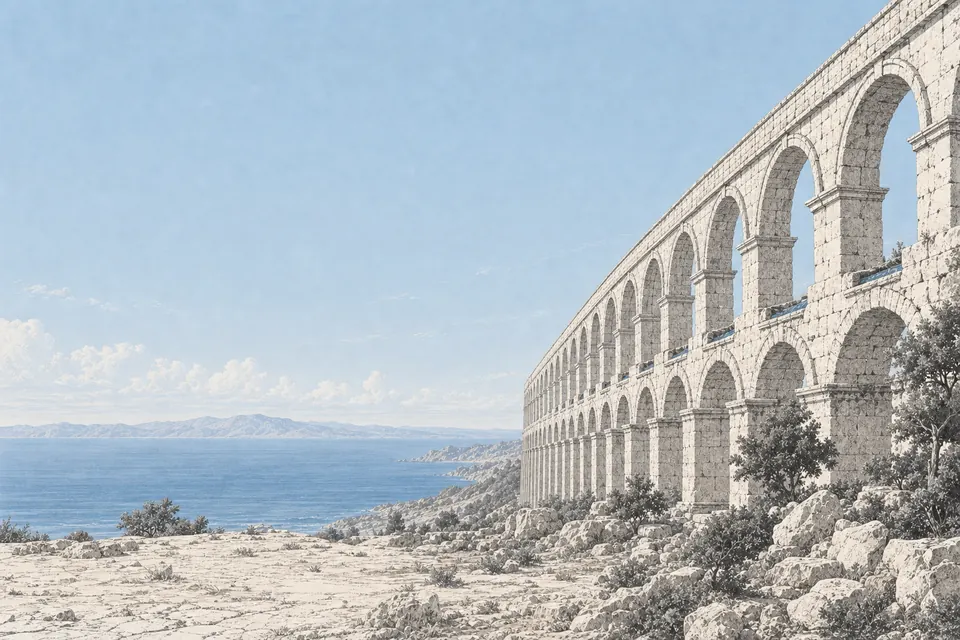
Fig. 10, The aqueduct: A stone aqueduct of two tiers of arches crossing a valley toward the sea, water visible in its channel.

What you’re up against

Every account is true from where its owner stands.

  1. 01

    The map nobody follows

    Every team knows its own piece. The map on the wall shows a process nobody quite follows.

  2. 02

    The delay everyone hands on

    Sales points at the warehouse, the warehouse points at sales, and finance waits for both.

Beneath the process

Order to invoice

Ask each team how an order becomes an invoice and you hear the version drawn here. Move the lens along it to see the same orders as the event history recorded them.

01Proof of delivery attached

Reported
With the delivery
Observed
53 hours later on average
Prescribed
With the delivery

02Ready to invoice

Reported
Same day
Observed
2.2 days on median
Prescribed
Same day

03Rush orders

Reported
Same process
Observed
Skip the handoff check
Prescribed
Same process

Illustrative. Orders, dates and figures are invented.

One investigation

A delay is a symptom. Find the explanation.

Follow one investigation from a sentence in an interview to a decision. The accounts and records are invented. The method is how Surface works.

  1. 01 What people said

    “The delivery is done. Then we spend days chasing the paperwork.”
    Operations coordinatorInvented excerpt
  2. 02 What the systems recorded

    Order event history

    EventRecordedCase
    Delivery confirmedMon 09:20ORD-018
    Proof of delivery attachedWed 14:10ORD-018
    Invoice readyWed 14:35ORD-018
    Invoice issuedWed 15:05ORD-018

    53 h between delivery and the paperwork that lets finance invoice

    The wait sits before the order is ready to invoice. Once the paperwork arrives, finance invoices within the hour.

    One case, traced across the recorded handoff. A time gap shows where to investigate; it does not establish the cause on its own.

  3. 03 A second account

    “Once we have the customer reference and proof of delivery, we can issue it. Usually we’re waiting for one of those.”
    FinanceInvented excerpt
    “Once we have the customer reference and proof of delivery, we can issue it. Usually we’re waiting for one of those.”

    A second account supports investigating the handoff. Check additional cases and exceptions before treating the explanation as established.

  4. 04 The procedure

    Handoff checklist

    Operations: done when

    • Delivery marked complete

    Finance: ready when

    • Delivery complete
    • Customer reference confirmed
    • Signed proof attached

    Two of finance’s three criteria are nobody’s job yet

    The two teams describe different completion criteria.

    • Operations: delivery marked complete.
    • Finance: delivery complete, customer reference confirmed, and signed proof attached.
    • Open question: who checks that all three are there?
  5. 05 The finding

    Finding for review

    The handoff is missing a shared definition of “ready”.

    Different teams use different completion criteria. An order can be delivered without the information needed to invoice it.

    Ruled outFinance capacity. Once the paperwork arrives, the invoice goes out within the hour, at month end too.

  6. 06 The decision

    Agree one handoff.

    Define the fields finance needs at delivery, and name who checks them.

    Owner
    Operations and Finance
    Next step
    Agree the three fields
    Compare
    Days to invoice next quarter

An illustrative investigation. Accounts and records are invented.

Who we talk to, what we read

Every team that touches the work, and the trail it leaves.

Surface talks to

  • Every team that touches the order
  • Their managers
  • Finance
  • Whoever owns the process, if anyone does

Surface reads

  • Event history with dates and a case reference
  • The trackers and spreadsheets teams keep
  • Exception and rework logs
  • Checklists, guides and the written process

In the pilot, Surface reads exports of the systems you already keep. A few months of events with dates and a case reference is usually enough. We check what you have in the first call.

What you come away with

The process, as described and as recorded, in one brief.

Each finding sets what people said beside what the event history recorded and what the procedure says, names the explanation it ruled out, and points to a decision with an owner.

  • Every finding links to the verbatim quotes behind it.
  • Numbers are calculated from stated inputs, not written by the AI.
  • Findings are checked across three independent runs. A headline that does not hold up is withheld.
Finding for reviewIllustrative

The delay starts before finance sees the order.

Reported
“The delivery is done. Then we spend days chasing the paperwork.”
Observed
53 hours from delivery to proof of delivery; under an hour from paperwork to invoice.
Prescribed
Proof of delivery attached with the delivery.

Ruled outFinance capacity. Once the paperwork arrives, the invoice goes out within the hour.

Decision
One agreed handoff
Owner
Operations and Finance
Compare
Days to invoice next quarter
See the examples

Before we begin

Questions people ask.

Is this process mining?

It reads the same kind of event history, and it hears from the people who do the work, so a wait comes with its explanation.

How much history do you need?

A few months of events with dates and a case reference, usually. We check what you have in the first call.

What do you need from our systems?

Exports of the events for the process in question, and any trackers the teams keep beside them. In the pilot, we work through the exports with you.

Do we have to know the problem already?

A question is enough to begin. The evidence may support it, change it, or point to a different question.

The offer

One question, ten people, one brief.

We agree one question about one process with you, interview up to ten of your people by voice or text, read the records that go with it, and take you through a brief that shows the evidence for every finding.

Book a conversation

Consultant, assessment firm or CX agency? Work with Surface

Illustrative evidence

Evidence

Invented material, written to show how evidence connects.